Cold Chain in a Dubai Summer: Where Loads Actually Get Lost
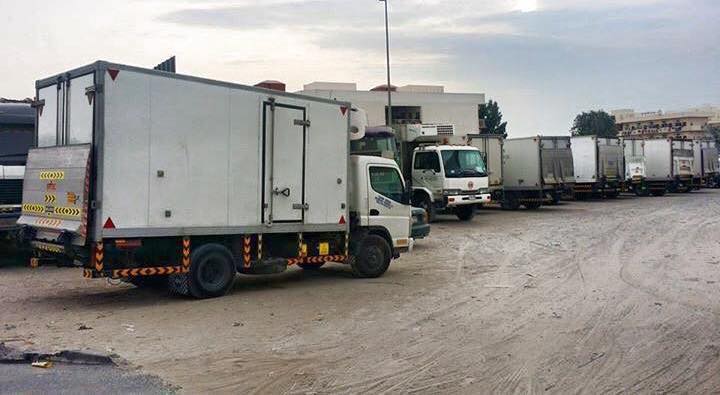
Ask someone where a cold chain breaks and they'll describe a broken-down truck on Sheikh Zayed Road. Almost never happens. The real failures are boring, they're on a loading bay, and they take about eleven minutes.
Dubai is a genuinely hard environment
Between June and September, ambient regularly passes 45°C. Asphalt gets considerably hotter. A metal box sitting in that sun is an oven that happens to have a fridge attached.
Every refrigeration unit has a pull-down rate — how fast it removes heat. Load a warm box with warm product and the unit spends the whole route catching up, arriving at temperature roughly when you arrive at the customer. That's not a working cold chain. That's a race you lost at the start.
Failure one: the warm box
The single most common failure in this city, and the easiest to fix.
The van leaves the yard at ambient. It drives to you, arrives at maybe 25°C inside, and the unit is running hard. Your product — already perfectly cold — goes into a box that's 25 degrees warmer than it should be.
The load surface warms immediately. On a multi-drop route, it never fully recovers, because every door opening resets the progress.
Fix: pre-cool before collection. Not on the way. Before. This is the question worth asking any provider, and the hesitation in their answer is the whole review.
Failure two: the open door
A driver opens the rear door, then goes to find the receiving clerk. The door stays open six minutes. In August, that's most of the cold gone.
Do it fifteen times on a multi-drop and by the last stop your box is nowhere near spec — regardless of how good the unit is.
Fix: door discipline. It sounds trivial. It's most of the job. Our drivers are trained to close the door before doing anything else, every time. It's not clever. It's just done.
Failure three: the engine-dependent unit
Cheaper refrigeration runs off the vehicle engine. Switch off the engine, and cooling stops.
Now picture a delivery in Business Bay: the driver parks, takes the goods up in the service lift, waits, comes back. Twenty minutes with no cooling, in a metal box, in the sun.
Fix: independent refrigeration that runs whether the engine is on or not. Our fleet is specified this way — it's why a van can hold temperature parked at an event venue all afternoon.
Failure four: nobody wrote anything down
This one doesn't spoil the load. It costs you the argument afterwards.
A supermarket rejects a pallet claiming a temperature breach. Without a record, you cannot prove otherwise. You eat the cost, the return trip and the credit note.
Fix: temperature monitoring with delivery reporting. We provide it on request, or as standard on contract accounts. It's less about proving you're right than about the conversation ending in thirty seconds.
Failure five: sending the wrong vehicle
Fresh product in a freezer van freezes. Frozen product in a chiller van softens. Both are total losses, and both start with someone booking by price instead of by temperature. We've written about that here.
What summer actually demands
- Pre-cool, always. Non-negotiable from June to September, sensible year-round.
- Shift your route earlier. A 6am collection is a different job from a 10am one. Al Aweer and the fish markets already know this.
- Shorten the bay time. Have paperwork ready before the door opens.
- Independent refrigeration. Ask. Don't assume.
- Get the record. Cheap insurance against an expensive dispute.
Why we're pedantic about this
We've run Dubai's cold chain since 2008, which means eighteen summers. In that time we've seen exactly which corners get cut and exactly what it costs — usually someone else's stock, occasionally an entire container of frozen product that had been perfect until the last forty minutes of its journey.
None of the fixes above are exotic. They're just discipline, applied every single time. That turns out to be the rare part.
If you want to talk about a route that's been giving you trouble, call 055 884 4722.
Related questions
What temperature does a chiller van reach in Dubai summer?
Ours hold your set point from +10°C down to -18°C, and -29°C on deep-freeze units — including through a 45°C August afternoon. The critical part is pre-cooling before loading, not the rated minimum.
Why does pre-cooling matter so much?
Because a refrigeration unit takes time to remove heat. Loading cold product into a warm box warms the product immediately, and on a multi-drop route it never recovers. Pre-cooling removes that problem entirely.
Should I move my deliveries earlier in summer?
Where you can, yes. A 6am collection faces far less ambient heat than a 10am one, and every degree you avoid is a degree the unit doesn't have to fight. It's why market runs start at dawn.
Need a chiller van today?
Tell us your route, temperature and timing — we'll confirm availability and a fixed rate on the call.