Transporting Medicines in Dubai: The 2–8°C Problem
Most cold chain has a tolerance band. Pharmaceutical cold chain has a window — and the window has a floor as well as a ceiling. That single fact makes it the hardest job in refrigerated transport.
Why 2–8°C is harder than -18°C
Counter-intuitive, but true. Deep freeze is a one-directional problem: get cold, stay cold, colder is never worse.
The pharmaceutical window is bounded on both sides. Above 8°C, many biologics degrade. Below 2°C — and this is the part people miss — freezing destroys a great many of them just as completely. Certain vaccines are ruined by a single freeze event. Some protein formulations aggregate irreversibly.
So you cannot simply set the van as cold as it goes and relax. You have to hold a six-degree corridor, in a city that spends four months above 40°C, with the door opening at every clinic.
The failure has no symptom
Spoiled fish smells. Melted ice cream is obvious. A vaccine that spent twenty-five minutes at 11°C looks exactly like a good one.
It goes into a fridge, then into an arm, and nobody learns anything until the immunity that should be there isn't. That's the entire reason this field is built on documentation rather than assurance.
In pharmaceutical transport, "we're careful" is not a claim. It's a request to be trusted about something nobody can verify afterwards.
Where excursions actually happen
The cold store handover
The most dangerous ten minutes. Product leaves a validated cold room and goes into a vehicle. If that vehicle isn't already at temperature, the excursion starts the moment the box is loaded — before the van has moved a metre.
This is why pre-cooling isn't a nice-to-have in pharma work. It's the whole control.
The clinic door
Multi-drop pharmacy routes mean many door openings. Each one bleeds the corridor. A driver who opens the door and then goes looking for the pharmacist has just spent your margin.
The van that's too cold
A well-meaning driver who thinks colder is safer and drops the box to -2°C has destroyed the load as surely as if he'd left it in the sun. This is a training problem, not an equipment problem.
What to demand from any provider
- Pre-cooling before collection. Ask directly. Listen to the pause.
- A monitored window, set to your spec. Not "cold". A number, which you provide.
- Temperature reporting on every consignment. If your quality agreement requires it, it should be automatic on the account, not something you remember to request.
- Drivers briefed on your SOP. If you have a procedure, the assigned driver should know it before the first run.
- A vehicle you can inspect. Before you sign anything.
Lab samples: same cold, different clock
Diagnostic samples add a second constraint. Temperature matters, but so does elapsed time — a sample outside its stability window is as useless as a warm one, even if it was perfectly refrigerated the whole way.
That makes sample transport a routing problem as much as a refrigeration problem, and it's why we take these on the phone rather than by email. If it's urgent today, call.
Which vehicle
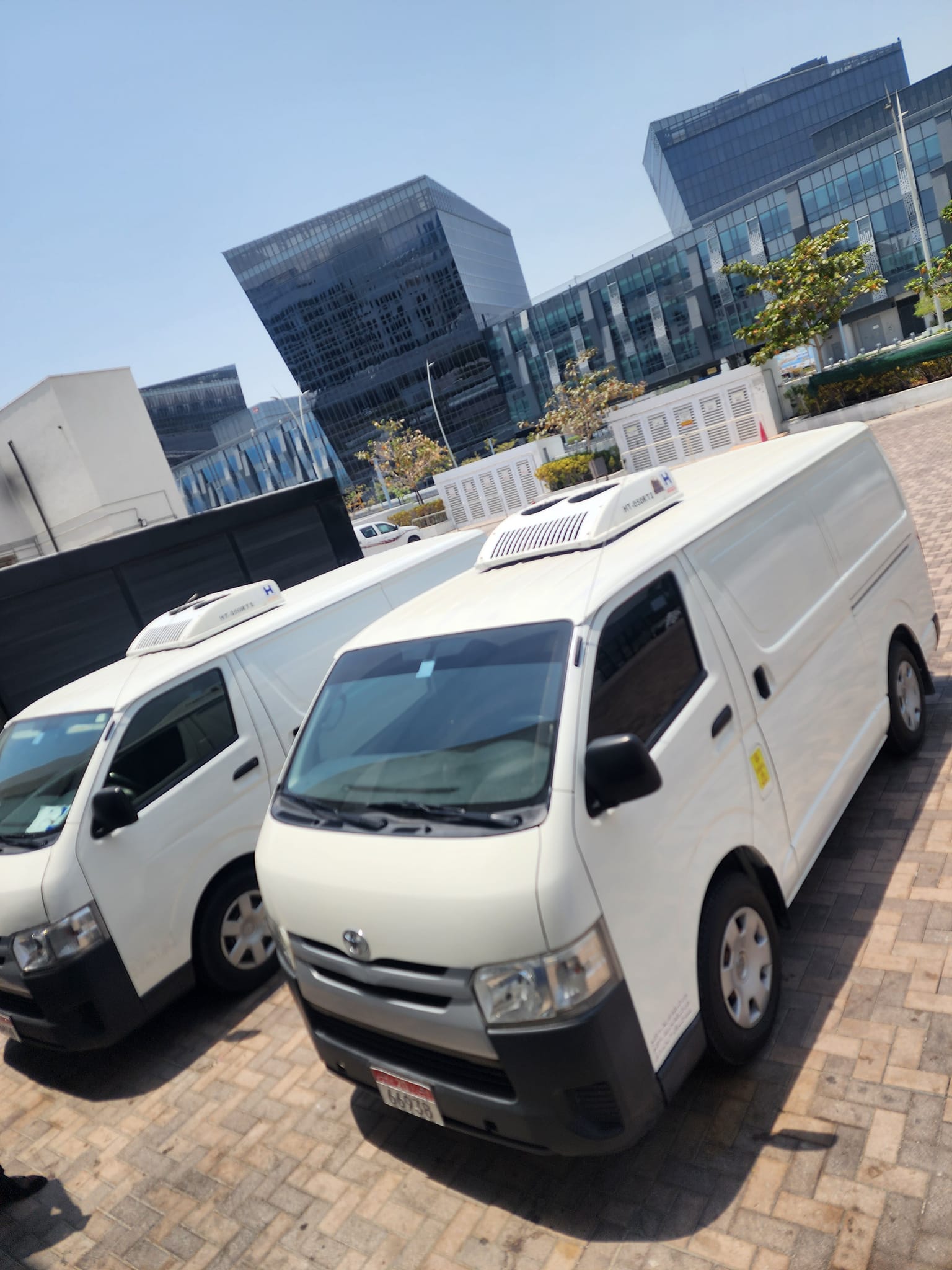
Almost all pharmaceutical work runs on a 1-tonne chiller van. The loads are light, the drops are many, and a van reaches clinic entrances a truck can't. For distributor-scale pharmacy replenishment, a 3.5-tonne chiller truck handles the volume.
More detail on how we run these routes is on our pharmaceutical transport page, or call 055 884 4722.
Related questions
Why can't you just set the van as cold as possible for medicines?
Because freezing destroys many biologics as thoroughly as heat does. Some vaccines are ruined by a single freeze event. The window is 2–8°C with a floor as well as a ceiling, so we set the van to your specification.
Do you provide temperature logs for pharmaceutical deliveries?
Yes — monitored through every run, with delivery reporting on request, or as standard on your account if your quality agreement requires it on every consignment.
Can you handle urgent lab sample runs in Dubai?
Yes. Samples have a time constraint as well as a temperature one, so call 055 884 4722 rather than emailing — the phone gets a vehicle moving faster.
Need a chiller van today?
Tell us your route, temperature and timing — we'll confirm availability and a fixed rate on the call.